

Peru
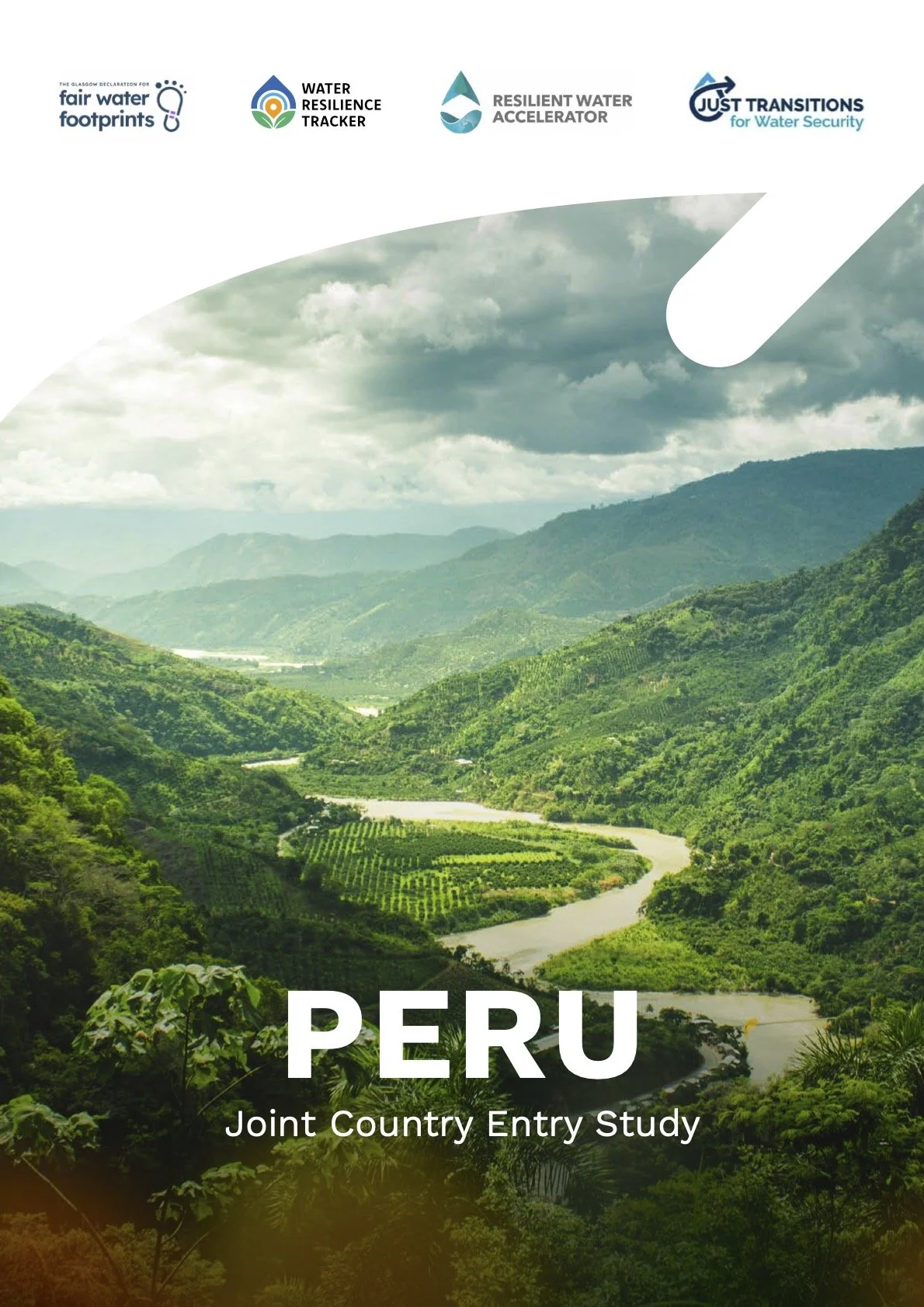
The Andes serve as Peru's main water source, feeding rivers that supply both the arid coast and parts of the Amazon. Despite this, water management remains a challenge due to uneven distribution, pollution, and insufficient infrastructure.
The UK Government's Just Transitions for Water Security (JTWS) aims to support better water management in the face of climate change.
The programme provides this support through three initiatives. Peru is one of five countries where these initiatives intend to jointly engage stakeholders from government, financial sectors, corporate and supply chain, as well as civil society.
-
Launched at COP26, FWF is a partnership between government, the private sector, financial institutions and civil society that aims to harness the power of trade, enterprise, and communities, to help deliver sustainable water and sanitation for all by 2030. Peru is currently a signatory to the FWE Declaration.
-
WRT is a tool and diagnostic guide which supports the understanding and enhancement of water resilience in national climate plans.
-
RWA works to design and develop replicable investment models that channel private and commercial finance to strengthen water security and climate resilience.
While not yet active in Peru, RWA is collaborating with JTWS partners to determine possible opportunities in the country.
Key opportunities for JTWS in Peru
Read our full analysis of the political, economic, social, technological, legal, and environmental factors shaping water security in Peru in our Joint Country Entry Study.
-
Leverage existing funding and investment mechanisms to provide investment into water
Continue to engage with other Government and non-state actors, including international organisations and investors
Seek structural reforms to financial institutions and the economy to support investment into the water sector.
Work with neighbouring countries to anchor transboundary water initiatives while being conscious of political stability.
-
Use Government strategies and plans to inform JTWS actions and monitoring and evaluation frameworks. dentify and seek emerging funding and investment opportunities - including sovereign bonds and the Green Climate Fund.
Seek to establish water stewardship arrangements with key sectors and consider the establishment of water tariffs.
Engage in ongoing projects in Peru including those with the Nature Conservancy, Natural Infrastructure for Water Security, and GCF support natural infrastructure and local resilience.
-
Identify opportunities to align water resilience and urban development in large cities and towns
Establish policy framework to support new and emerging practices in water security.
Establish capacity development programmes to upskill the public and professionals.
Strengthen enforcement of water quality standards. Integrate health surveillance with water monitoring to guide targeted interventions
Incorporate a gender and social inclusion (GESI) lens, ensure community participation, and promote cross-sectoral coordination at all levels of water governance.
-
Undertake an assessment of water footprints to understand Peru's contribution to virtual water flows.
Advocate for the rehabilitation of existing dams to recover lost storage capacity due to siltation.
Encourage decentralised wastewater treatment, especially in rural areas.
Prioritise 'no-regret' options to improve water efficiency and use in municipal and agricultural sectors.
Utilise the Multi-Capitals approach for cost and benefits analysis during project design and implantation
-
Enhance coordination, better define roles and responsibilities, and improve enforcement within the existing legal frameworks and through these institutions Encourage local participation in water management through the existing water user organizations (WUOs),
Develop the legal context of Corporate Social Responsibility (CSR) to ensure that it aligns with national and international standards and ensure it is enforceable
-
Support local water committees to manage water resources at the community level
Take an integrated approach to adaption measures, across different sectors such as water, agriculture, industry and mining.
Promote nature-based solutions, such as the conservation of water recharge areas and the use of water-efficient crop varieties.